DTG T-Shirt Printing in Denver
Direct-to-Garment T-Shirt Printing
Full-color printing for detailed artwork, photographs and smaller orders. DTG prints the image directly onto the garment without building a screen for each color.
Direct-to-garment printing, usually called DTG, is a good option when your design has a lot of color or fine detail and you do not need a large run. Unlike screen printing, DTG does not require a separate screen for each color, so it works well for smaller quantities and detailed artwork.
Advantages
– Get just one, full color item!
– Get a few full color affordably.
– Water based inks ( environmentally friendly with a soft feel)
– No set up charges. ( silk screen stencil )
– No ink mixing. No press registration.
– No mechanical art or films.
– Hi resolution (4800 pixels per inch).
– Large format print ( 16″ X36″ )
– Millions of colors at no extra charge.
– Quicker turnaround time.
We’ve made it even easier and more cost effective with our new online designlab. This software allows you to upload your photo or graphic, add clip art, text and much more all for FREE, saving you from an art charge to produce a high resolution professional file. Our Viper print system uses a white ink management system that allows us to print on any color t-shirt including black and dark colors.
Disadvantages
This process does not allow for quantity discounts.
It can’t print custom colors like neon’s glitters etc.
Pantone color matching not possible.
Direct to garment is perfect for those smaller run orders, especially those using full color. If you are in a hurry this is also the ideal process for those custom t-shirts & hoodies. With our online design lab, you can upload a pre-existing design or create a new one. Use it to embellish a photo or design. All artwork comes through as print ready. We’ve loaded dozens of fonts to arch, color and manipulate as you like. There is a database of clipart to choose from or an upload area to load your own artwork or design. The design lab will show you all cost as you go. We except all major credit cards, Paypal or even phone in orders. As with all the custom decorated garments at Choice Image Inc. all work is done right here in our Lakewood, Colorado facility.
“We only make your custom t-shirts LOOK more expensive!”
What’s the deal with this ” digital t-shirt printing”? Is it the same as ” print on demand”?
Digital t-shirt printing is starting to come of age. Since BASF has developed a white ink for use in bubble jet and ink jet printers along with a curable textile ink, companies can now print onto garments or textiles using the same printing technologies as the desktop printer attached to your home’s personal computer system.
What are the pros & cons of digital tee shirt imaging as compared to other processes like heat transfers, sublimation or silk screen printing?
Unlike heat transfers or sublimation, digital printing can now be done right onto colored garments as a white ink can be applied first. Heat transfers do come in white, however each transfer must be cut out of the square or rectangular paper and applied. It leaves a big plastic window on the garment. Sublimation can only be done on polyester goods and not 100% cotton.
Silk screen printing was invented in Asia some 4000 years ago. It has come a long way since then using discoveries in modern technology and materials.. It is THE standard in imaging anything textile.!
HERE IS A BREAKDOWN OF SOME OF THE PRO’S & CON’S OF PRINT ON DEMAND CUSTOM T-SHIRTS AS COMPARED TO THE INDUSTRY STANDARD OF SILK SCREENING.
1.) PRICE: There are no set ups associated with this form of reproduction. This means mechanical color separated films and screens are not needed. This is a major cost saving factor and has made it affordable to do just one or two full color printed items. Please see the number one con as an opposite effect of this.
2.) TIME: If you find a shop that does not have a lot of orders going on at the time, it is possible for shirts to be done while you wait do to the lack of set ups required.
1.) PRICE + TIME: Digital printing is a slow process as compared to silk screening. With the silk screen process, once the job is set up , hundreds of full color garments can be produced on just one press in 30 minutes or less.
Digital printing may take that long just to spray one shirt. Silk screening can reproduce t-shirt quantities at 500 percent faster than digital.
This means you can get MAJOR price breaks for ordering quantities of silk screen printed shirts whereas digital printing does not give you a price break for quantities! This can be the difference from $3.00 bucks a tee compared to $8.00 to $20.00 a shirt.
Also in this area, is the fact that you pay the same price for a one color digital print as a full color digital print. Screen printing charges per color and can generate free mixed tertiary colors on press as well.
2.) QUALITY: Digital printing sprays the ink onto the garment whereas screening uses a squeegee with pressure to push the ink into the fiber, thus completely permeating the material. In fact most digital printers spray an alcohol down first just to get the ink to slightly absorb into the textile weave a few millimeters below the surface. Screen printing can also use different meshes of screen to adjust thick or thinner deposits of ink.
These inks fade quickly from sunlight, laundering and wear. Silk screened shirts…. “I still have a Pink Floyd shirt from the seventies, the shirt is falling apart but the print still looks great”.
3.) SPECIAL EFFECTS: Unlike silk screening, digital print on demand cannot print creative custom effect inks like.. glitters, shimmers, metallics, glow in the dark, neon, fluorescent black light, puff & raised, color changing ultra violet chromatic, clear gel gloss, foils, suede, light reflective, vinyl, Lycra & specialty material inks, as well as exact pantone color match inks.
Color matching, digital cannot do a color match! In fact, re-orders may result in an image that is completely different in color!
3-D effect, digital printing does not offer killer effect that can be done by a screen printer like, high density printing, fake process, indexing, flamingo printing and a whole host more.
Digital direct to garment is ideal for getting just one full color, large format printed clothing item. No art or set up charges, fast turn around. Item needs to be 100% cotton. Currently, we do not print supplied goods due to the spoilage rate associated with this process.
DIGITAL DIRECT TO GARMENT T-SHIRT PRINTING OR (DTG).
WHAT IS IT? WHY USE IT?
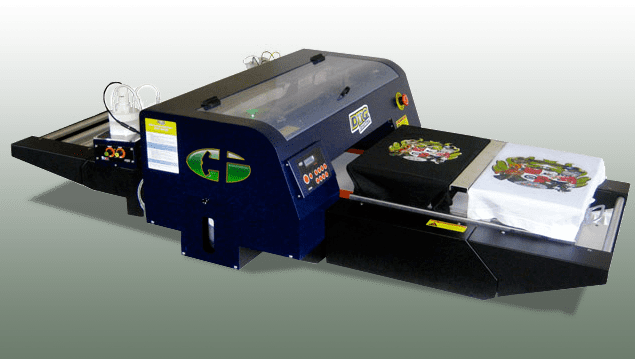
DTG printing takes a digital image and prints it directly onto the garment using water-based textile inks. That makes it a strong choice for detailed artwork, photographs and designs that would require many screens with traditional screen printing.
Our DTG equipment can handle full-color artwork on both light and dark garments. The usable print area depends on the garment and placement, so we review the design before production and size it for the best result.
Because DTG does not require a separate screen for each ink color, it is often a better fit for smaller quantities and designs with many colors. For larger runs or simpler artwork, screen printing may still be the more economical choice.
The finished look can range from photographic detail to illustrated artwork, depending on the original file and garment. If you are unsure whether DTG or screen printing will give you the better result, we can compare both options before you order.
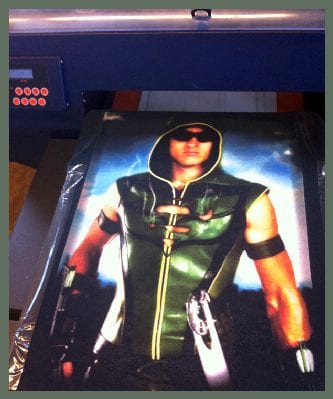
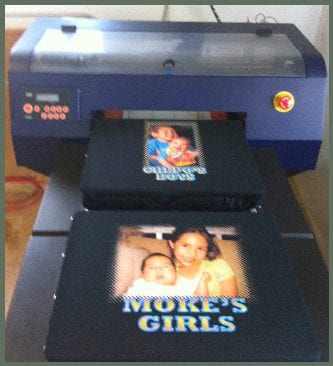
So, why would you choose traditional silk screen printing over direct to garment?
Silk screen printing is the standard for making custom tee shirts and printed apparel. It’s been around a long time and has been honed and perfected. With DTG shirt printing, there are several limitations. While the ink is now color fast and will hold up to repeated washing and laundering, the print process itself is limited to the CMYK color gamut. CMYK stands for the four inks used in computer printers. ( just like the one on your desk) Cyan ( Blue) Magenta ( Red) Yellow and K ( Black). Between these four colors, the printer can generate some 25,000 tints tones and color blends.
Unfortunately, many things created with computer graphics use the RGB color spectrum or gamut. R ( Red) B ( Blue) and G (Green) these are the three colors of the light emitting diodes of a digital display like tv’s smartphones, computer monitors and such. This color spectrum can create some very intense neon colors that cannot be reproduced with the CYMK gamut.
Another limitation of digital tee shirt printing is color accuracy. Many company logos and graphic designs use a specific color or hue. Digital imaging cannot reproduce an accurate color each time. In fact, many times what the customer thought was a blue image may print on the t-shirt looking purple. A flesh-tone may look like a suntan or sunburn.
Silk screen printing on the other hand offers complete color accuracy as well as a host of custom inks from EVERY spectrum. Some of the inks offered with the traditional screening process are…